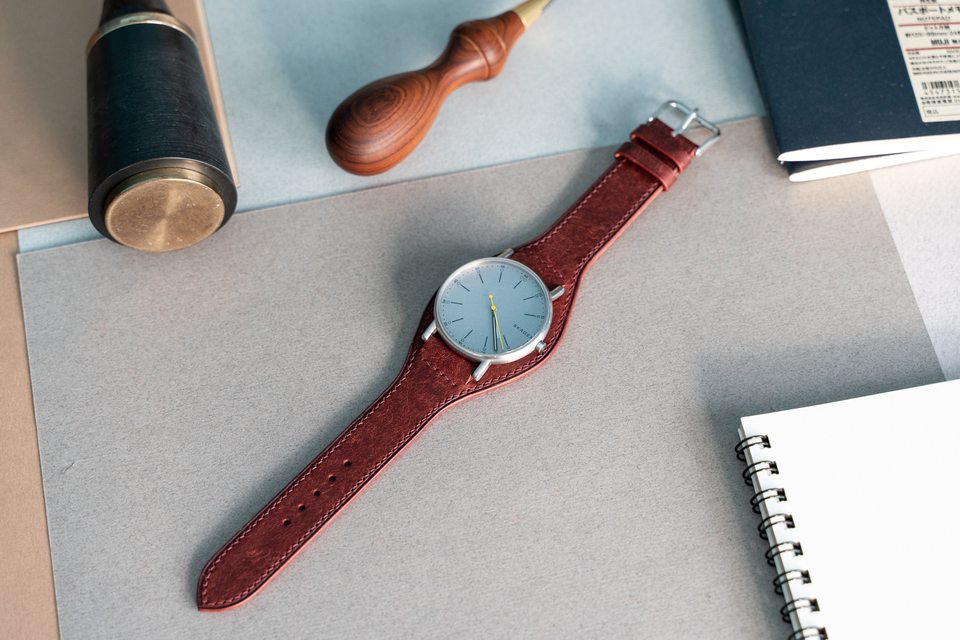
Practical guide · 3 min
What is a Bund strap?.
A close look at the leather beneath the case, the watch attachments and the outline of a slim Bund strap.
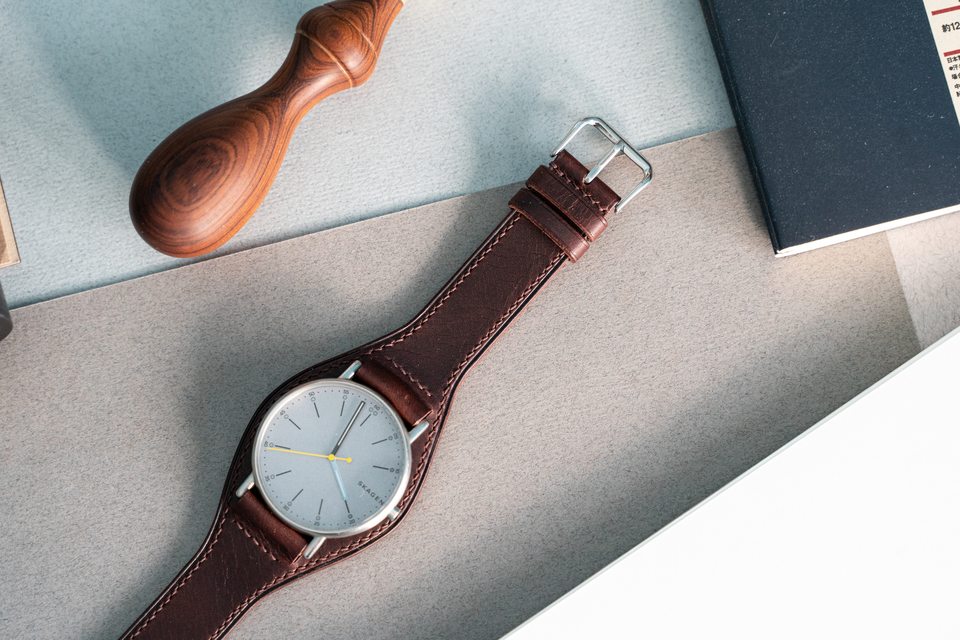
Start beneath the watch
The defining feature of a Bund strap is the leather beneath the watch case. Look at the case from above and you can see that leather continuing around it. From the side, you see the case resting over another layer. That extra shape is what gives a Bund its particular outline.
In the slim examples in this archive, the leather broadens around the round case, then narrows towards the buckle and the pointed end. The visible border is quite close to the watch. These pieces show how a Bund can have a shaped, restrained outline without a large rectangular pad.
Follow the construction
Our photographs without the watch fitted are especially useful here. The broad centre remains visible, with two folded leather attachments facing one another. Those attachments meet the watch at its lugs. You can follow the outer edge from one end of the strap, around the centre, and towards the other end.
A fitted watch covers much of this construction. The empty view explains which parts belong to the strap and which apparent edges were simply shadows beneath the case. When comparing Bund designs, look for both views: one with the watch installed and one that shows how the leather is arranged underneath.
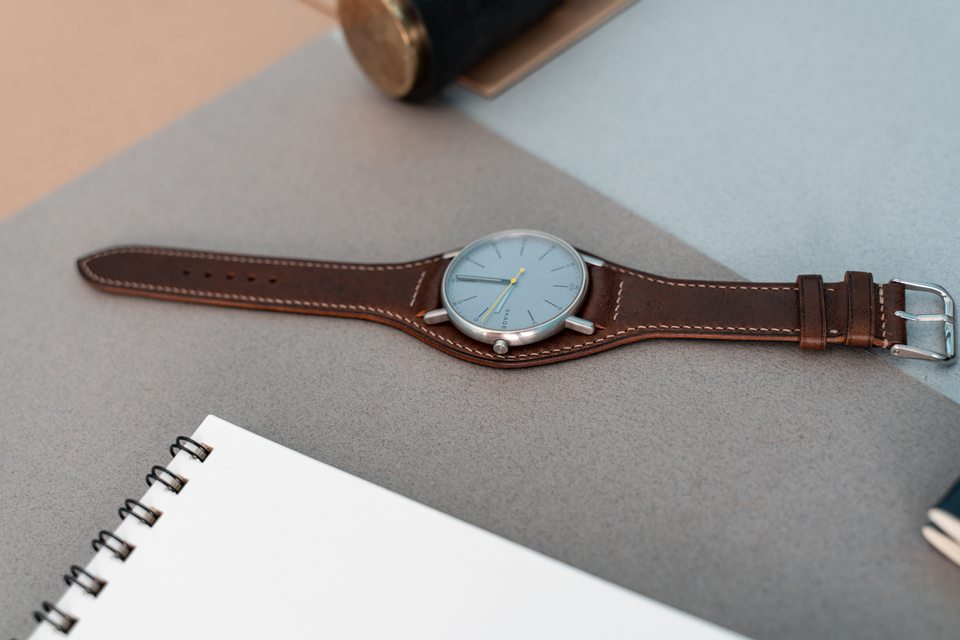
Read the outline in three places
First, look at the leather beside the widest part of the case. A visible margin frames the watch. Next, follow the shoulders where that margin narrows towards the strap. A long curve and an abrupt step create quite different shapes, even when the leather is the same colour.
Finally, look near the lugs. This is where the watch attachment, the case and the wider base meet. In our slim examples, the perimeter stitching makes the outer curve easy to follow, while short transverse rows identify the ends of the upper leather sections. A close photograph can explain more than the overall colour name.
Keep attachment width and pad width separate
The width at the watch attachment and the width of the leather beneath the case answer different questions. The first concerns the connection to the watch. The second describes the wider outline you see around it. A single strap-width figure cannot describe the complete shape of a Bund.
When discussing a strap, identify the watch and show the proportions you like. A reference photo is useful for the outline; actual measurements are needed for the attachment and fit. The side view matters too, because an overhead photograph gives little sense of the combined height of case and leather.
- Front view: the border around the case and the curve of the shoulders.
- Side view: the relationship between the case, attachment and base.
- Unfitted view: the construction hidden beneath the watch.
Use the archive as a reference
The related works show this construction in several colours. Open a full series to compare the fitted view with the details, then save the work that best describes the shape you have in mind. These are archive examples; Asketica is the place to check current information and available options.